
Foundation for NATIVE TREES Ltd.
The forests of Kenya require native African trees to thrive. Make a DonationSeedlings Available NowAbout Our Foundation
Environmental Needs
In summary, the forests of Kenya face several serious problems the Foundation for Native Trees needs to address including.
- Deforestation and habitat loss.
- Non-indigenous or invasive species of trees.
- Ongoing needs for wood for fuel and building material.
- Preservation of Endangered species of indigenous trees.
Foundation for Native Trees
Our Mission
Our foundation promotes sustainable forestry, plants indigenous trees, educates and raises awareness to build a greener future for communities and ecosystems.
About Our Foundation
Our Objective
- Set up of large-scale indigenous tree nurseries to serve as the source for tree planting efforts.
- Large scale tree planting exercises using both our own staff and supervised casual labour.
- Establishment of bamboo plantations to serve as an alternative sustainable source of fuel.
- Establishment of quick growing hardwood varieties to provide community needs for building materials.
- Public awareness efforts to encourage more small-scale farmers and land owners to choose indigenous trees.
- Engagement of the relevant local government officials to get their support in the allocation of potential tree planting sites and to prevent ongoing deforestation.
- Technical Expertise Education & Training of small-scale nursery owners in methods of propagation of indigenous trees with emphasis on the appropriate trees for different habitats.
- Fund raising efforts to support the objectives as stated.
Focus Areas
The Biggest Impact

Environmental damage as the greatest threat to the planet
There is now universal agreement that environmental damage is the greatest single threat to our planet.
Tree planting efforts to reverse environmental damage.
To reverse this process, much emphasis has been placed on tree planting and this has taken the form of both large scale and small-scale tree planting efforts.
Problems with planting non-indigenous trees
Unfortunately, here in Kenya, non-indigenous trees have been planted throughout large areas of the country. The detrimental effect of the widespread introduction of non-indigenous or invasive species has been well documented.
Importance of community involvement in sustainable use of resources
Community involvement is vital to ensure that these plantations are used in a sustainable fashion.
More +
- Establishment of bamboo plantations to serve as an alternative sustainable source of fuel.
- Establishment of quick growing hardwood varieties to provide community needs for building materials.
- Public awareness efforts to encourage more small-scale farmers and landowners to choose indigenous trees.
- Large scale tree planting exercises.
- Engagement of the relevant local government officials to get their support in the allocation of potential tree planting sites and to prevent ongoing deforestation.
- Technical Expertise Education & Training of small-scale nursery owners in methods of propagation of indigenous trees with emphasis on the appropriate trees for different habitats.
Human activity leading to destruction of natural vegetation and indigenous forests.
Human activity has resulted in the destruction of vast areas of natural vegetation and indigenous forest leading to degradation of the water tables, habitat loss and ultimately to a loss of biodiversity and extinction of species.
Set up of large-scale indigenous tree nurseries to serve as the source for tree planting efforts.
Efforts to address community needs for fuel and building materials.
We also recognize the need to address the community needs for sources of fuel and building material to mitigate destruction of surviving forests. To this end we intend to approach the county governments for land that can be used to plant native varieties of quick growing trees as a source of hardwood and bamboo varieties that can be used in a sustainable way to provide fuel.
The impact of invasive species in Kenya
Native trees represent an important anchor in the environment and have co-evolved with insect, animal, and other plant life over millennia. The three primary invasive species in Kenya include Grevillea Robusta (Australia), Eucalyptus species (Australia) and Casuarina Species (Australia). These species were introduced to Kenya in the last century and have become widespread at the expense of indigenous trees. Many indigenous trees are coming under increased threat with some even being listed as endangered. The destruction of indigenous forests continues throughout the country and tree planting efforts are yet to match the rate of loss.
More +
The Foundation for Native Trees aims to address this problem by promoting awareness, by providing seedlings and by organizing large scale planting of native African tree species around the country. We have several nurseries and intend to acquire land to establish sanctuary sites where diverse native species can be planted and protected for preservation.
The scale of the problem and need for community involvement.
The scale of the problem is immense. We recognize that we will not make a significant impact without the involvement of the communities and county governments. There are countless small nurseries throughout the country that serve as the primary source of inexpensive seedlings to small hold farmers. It will be important to educate the owners as to the value of indigenous trees and to provide them with a ready source of affordable seeds. Subsidized seedlings will also be provided through schools, churches, and community-based self-help groups.
Some of the native tree seedlings available in the tree nursery:
- Milicia excelsa
- Vitex keniensis
- Cordia africana
- Podocarpus
- Trichilia emetica
- Mysospis eminii
- Prunus africana
- Olea capensis
- Olea africana
- Markhamia lutea
- Moringa stenopetala
- Calodendrum capense

Milicia Excelsa seedlings

Milicia excelsa
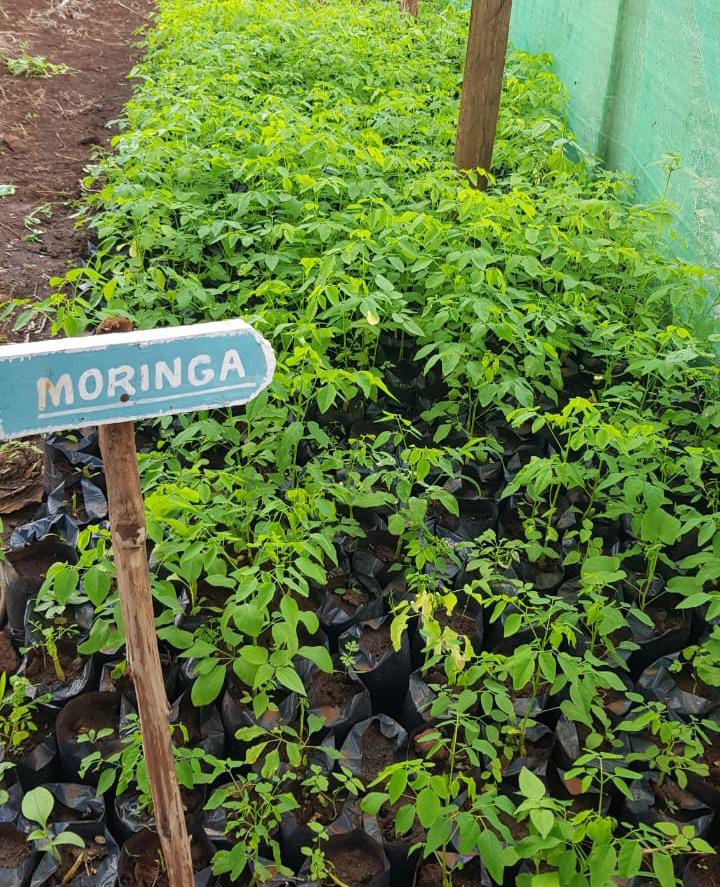
Moringa Stenopetala
